
TRANSMIT's New Publication: “Visually Transparent and Scalable Cu(In,Ga)Se2 Solar Cells Through Spatial Segmentation”
The TRANSMIT project proudly presents its new publication “Visually Transparent and Scalable Cu(In,Ga)Se2 Solar Cells Through Spatial Segmentation”, featured in Solar RRL.
The study explores spatial segmentation to pattern CIGS into micro-stripes as a pathway to developing transparent solar cells without compromising thickness or efficiency.
Key results include an active-area efficiency of 10% and an average visible transmittance of 40%, achieved while retaining a Color Rendering Index of 98.9.
This publication marks a significant milestone in the project's mission to integrate high-performance semi-transparent photovoltaics (STPV) into buildings.
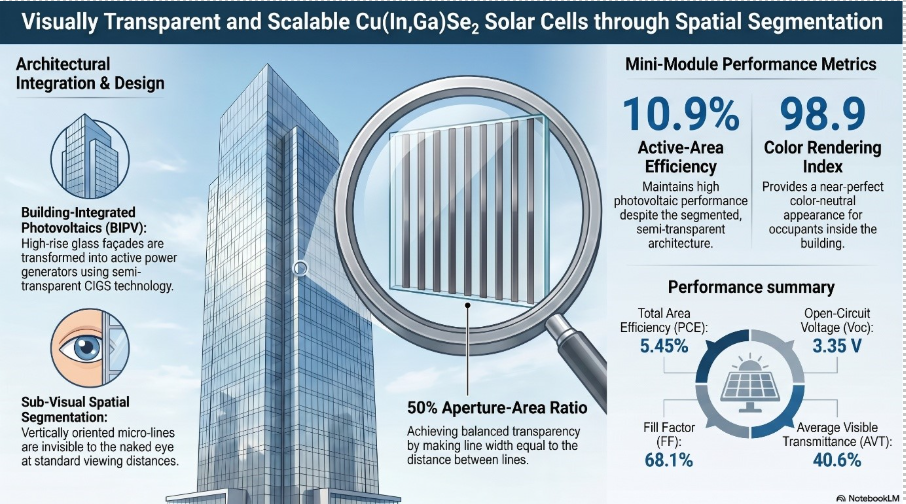
Image generated with NotebookLM
Abstract
Semi-transparent photovoltaics aim to integrate power generation into building windows without compromising visual neutrality. Yet, most approaches achieve transparency by thinning the absorber layer, which reduces efficiency and leads to transmission of tinted light. Spatial segmentation provides an alternative where transparency is set by the aperture-area ratio, while the full absorber thickness and its photovoltaic quality can be preserved. We implement this concept in Cu(In,Ga)Se2 thin-film solar cells using a bottom-up approach that defines sub-visible micro-stripes prior to deposition and supports the efficient use of absorber material. To demonstrate scalability, we fabricate and characterise a semi-transparent mini-module with a series interconnection along the segmented stripes. The mini-module has 40% average visible transmittance and achieves 10.9% active-area efficiency, resulting in a light-utilisation efficiency of 2.2%, while retaining a colour-neutral appearance. These results show that geometric segmentation can translate full-thickness thin-film absorbers into viable, visually non-obtrusive photovoltaic windows, offering a practical route towards high-performance building-integrated photovoltaics.
Read the full paper: https://doi.org/10.1002/solr.70347